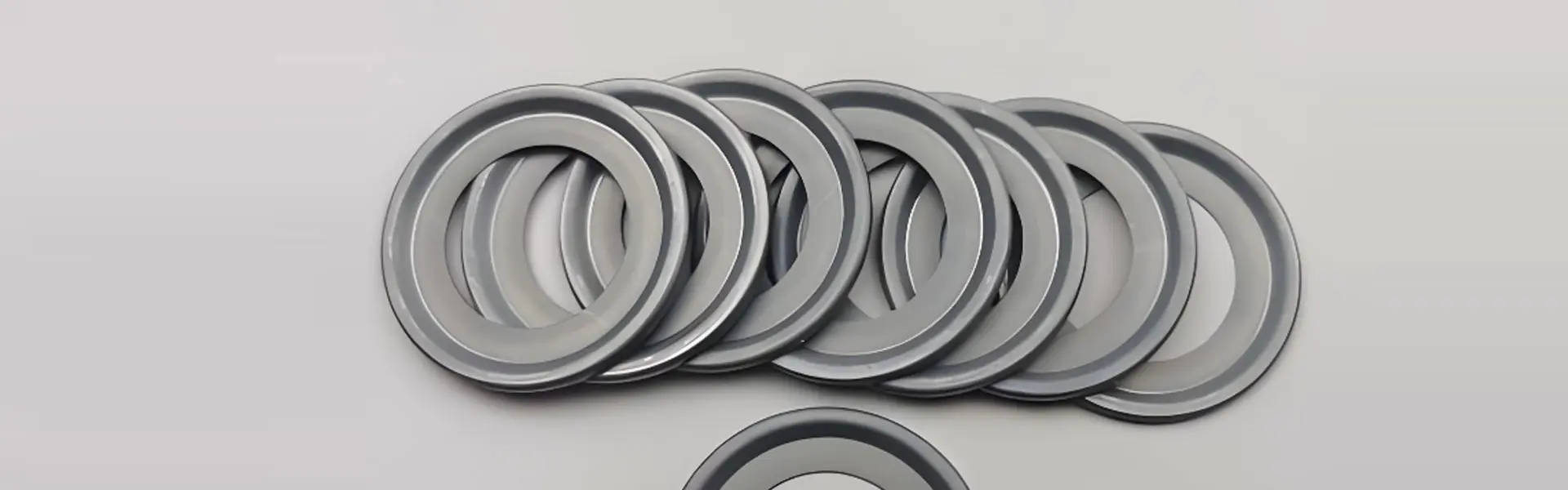
Can PTFE and PEEK seals be customized for specific applications? Absolutely. For procurement specialists navigating the complexities of sourcing high-performance sealing solutions, finding the right custom component is often the key to project success and operational reliability. This article explores the vast customization possibilities of PTFE (Polytetrafluoroethylene) and PEEK (Polyetheretherketone) seals, directly addressing the specific challenges faced in industries from aerospace to semiconductor manufacturing. We will provide actionable insights and clear guidance on how tailored seals solve real-world problems, featuring real application scenarios and detailed technical data to inform your next purchasing decision.
Article Outline:
A procurement manager for a chemical plant faces recurring seal failures in a sulfuric acid processing unit operating at 150°C. Standard elastomeric seals degrade rapidly, causing unplanned downtime, safety hazards, and costly maintenance. The core problem is material incompatibility coupled with thermal stress.
Customized PTFE seals provide the ideal solution. PTFE is inherently inert, resisting virtually all aggressive chemicals, including strong acids and bases. For this high-temperature application, a custom-designed PTFE seal reinforced with specific fillers like carbon or glass can be engineered. This enhances creep resistance and dimensional stability under thermal cycling, ensuring a longer service life and eliminating frequent replacements. Ningbo Kaxite Sealing Materials Co., Ltd. specializes in formulating such filled PTFE compounds, tailoring them to withstand specific chemical and thermal environments precisely, thereby solving the plant's reliability issue.
| Parameter | Standard PTFE Seal | Customized Filled PTFE Seal (e.g., for Sulfuric Acid) |
|---|---|---|
| Max Continuous Temperature | 260°C | 260°C (with improved creep resistance) |
| Chemical Resistance | Excellent (Universal) | Excellent, Optimized for Strong Acids |
| Creep Resistance | Low | High (with carbon/glass filler) |
| Typical Lifespan in Harsh Service | 6-12 months | 18-36+ months |
In a semiconductor fab, a sourcing engineer must find seals for a wafer etching tool that cannot introduce any contamination. Outgassing of seal materials can deposit particles on silicon wafers, leading to catastrophic yield loss. The challenge is finding a seal material that is ultra-pure, vacuum-compatible, and can withstand plasma exposure.
This is where custom high-purity PEEK seals excel. PEEK can be manufactured and machined to exceptionally high purity grades, minimizing outgassing and ionic contamination. For semiconductor tools, seals are often customized with specific surface finishes to reduce particulate generation and designed with precise geometries to ensure perfect fit in complex vacuum chambers. Can PTFE and PEEK seals be customized for specific applications? Yes, and for cleanrooms, companies like Ningbo Kaxite Sealing Materials Co., Ltd. offer PEEK seals produced in controlled environments, with material certifications and surface roughness (Ra) values tailored to meet stringent SEMI standards.
| Parameter | Commercial-Grade PEEK | Custom High-Purity PEEK Seal (Semiconductor Grade) |
|---|---|---|
| Outgassing (Total Mass Loss) | ~1.0% | < 0.1% |
| Surface Finish (Ra) | ~1.6 μm | < 0.4 μm (mirror finish available) |
| Extractable Ions (Na+, K+, Cl-) | Moderate | Extremely Low / Certified |
| Application | General Mechanical | Vacuum Chambers, Plasma Etch Tools |
An automotive R&D team is designing a new high-performance fuel system requiring seals that handle high pressure, constant dynamic motion, and exposure to bio-fuels at sub-zero to elevated temperatures. Off-the-shelf seals fail under combined stress, risking leaks and system failure.
A custom-engineered PEEK-based seal provides a robust solution. PEEK's outstanding mechanical strength, wear resistance, and fatigue endurance make it perfect for dynamic sealing. Customization involves selecting the optimal PEEK grade (e.g., 30% carbon fiber reinforced for extreme strength and low friction) and designing a seal profile (like a combined lip and spring-energized design) that maintains sealing force across the entire temperature and pressure range. This level of customization ensures reliable performance in the most demanding applications.
| Parameter | Standard PTFE Dynamic Seal | Custom Carbon-Fiber PEEK Seal (for Fuel Systems) |
|---|---|---|
| Tensile Strength | 25-35 MPa | > 200 MPa |
| Wear Factor (K) | ~3000 x 10-10 mm3/Nm | ~100 x 10-10 mm3/Nm |
| PV Limit (Dry) | Low | Very High |
| Operating Temp. Range | -200°C to +260°C | -50°C to +300°C (short term) |
Effective customization follows a structured process. It begins with a detailed application review: understanding the fluid media, pressure, temperature cycles, dynamic/static nature, and space constraints. Next, material selection is critical—choosing the base polymer (PTFE or PEEK) and any necessary fillers (graphite for lubrication, carbon fiber for strength, etc.). Then, engineering design takes over, creating precise CAD models for complex geometries like custom flanges, intricate profiles, or spring-energized designs. Prototyping and rigorous testing (for leak, friction, wear, and chemical resistance) validate the design before full-scale production. Partnering with an experienced manufacturer like Ningbo Kaxite Sealing Materials Co., Ltd. ensures this process is seamless, providing expert guidance from concept to delivery of a seal that perfectly fits your application's unique demands.
Q1: Can PTFE and PEEK seals be customized for specific applications that involve both extreme temperatures and aggressive chemicals?
A1: Yes, this is a common and critical customization area. For instance, PTFE can be compounded with specific fillers like carbon or graphite to enhance its mechanical properties (reducing creep and cold flow) while retaining its supreme chemical inertness. For even higher temperature and chemical resistance with superior strength, PEEK is the material of choice. The customization lies in selecting the exact polymer grade and filler package to create a seal that performs reliably in your specific combination of thermal and chemical stress.
Q2: What information should I provide to a supplier like Ningbo Kaxite Sealing Materials Co., Ltd. to get an accurate quote for a custom seal?
A2: To ensure an accurate and efficient quotation, provide as much detail as possible: Detailed application description (equipment name and function), Operating conditions (media, concentration, temperature min/max, pressure), Dimensional requirements (drawings or samples are ideal), Performance expectations (lifecycle, regulatory standards), and Quantity needed. This information allows their engineering team to propose the optimal material and design solution.
When your projects demand sealing solutions that go beyond standard catalogs, partnering with a specialized manufacturer is essential. Ningbo Kaxite Sealing Materials Co., Ltd. is a leading expert in the custom engineering and production of high-performance PTFE and PEEK seals. With deep technical expertise, we work directly with procurement and engineering teams to develop seals that solve specific operational challenges, enhance reliability, and reduce total cost of ownership. Visit our website at https://www.top-seals.net to explore our capabilities, or contact our engineering team directly via email at [email protected] to discuss your application requirements.
Deng, M., Shiono, T., & Sasaki, S. (2015). Study on the sealing performance of PTFE seals under high temperature and high pressure. Tribology International, 92, 480-489.
Kurtz, S. M. (2012). PEEK Biomaterials Handbook. William Andrew Publishing.
Li, Y., Wang, Q., & Wang, T. (2017). A review on the properties and applications of polyetheretherketone (PEEK). Polymer Testing, 63, 100-109.
Myshkin, N. K., & Petrokovets, M. I. (2010). Friction and wear of polymers and composites. Tribology of Polymeric Nanocomposites, 2, 3-37.
Odiotti, M., et al. (2019). Mechanical and tribological characterization of carbon fiber reinforced PEEK for seal applications. Wear, 426-427, 658-665.
Punkc, G., & Burkhart, T. (2011). Surface modification of PTFE for improved adhesion and sealing. Journal of Applied Polymer Science, 121(2), 972-979.
Rhee, S. H. (2016). The effect of filler on the friction and wear behavior of PTFE composites. Wear, 354-355, 56-61.
Sawae, Y., & Yamamoto, A. (2014). Influence of contact conditions on the tribological behavior of PEEK in aqueous environment. Tribology Online, 9(4), 227-233.
Shi, Y., Feng, X., Wang, H., & Lu, X. (2013). Effects of temperature on the mechanical properties of filled PTFE. Materials & Design, 46, 810-815.
Zhang, Z., et al. (2018). Development of high-performance PEEK composites for extreme environment sealing. Composites Science and Technology, 168, 142-148.